Revenue Guardrails are financial controls embedded directly in the sales process - between your quoting system and your financial ledger - to ensure every deal is structured for accurate revenue recognition before it closes. This post defines the category, explains why it exists now, and shows what changes when you deploy it.

The Short Answer
Every enterprise revenue stack is missing a layer. That layer is Revenue Guardrails. They are not a metrics framework. They are not a feature inside your CPQ (Configure, Price, Quote) system or your ERP (Enterprise Resource Planning) platform.
Revenue Guardrails are a specific, missing layer of the enterprise revenue stack - the set of financial controls and compliance rules that should live between the moment a deal is quoted and the moment revenue is recognized. Without them, finance teams catch structural deal errors after the fact. With them, the errors never happen.
This post defines the category precisely: what it is, what it is not, why it exists now, and what deploying it changes for your organization.
Four Problems. One Source.
Over the past eight weeks, this series has traced a single problem through four different lenses. We looked at why sales and finance rarely agree and what that misalignment actually costs. We examined why most companies cannot tell you whether a specific deal was profitable until weeks after it closed. We mapped the structural gap between CPQ and ERP that turns every period close into a manual reconciliation exercise. And we showed why forecast failure is a data problem, not a sales problem.
Four symptoms. One source. A gap in the enterprise software stack that neither CPQ nor ERP was designed to fill — and that costs the average enterprise up to 15% of revenue.
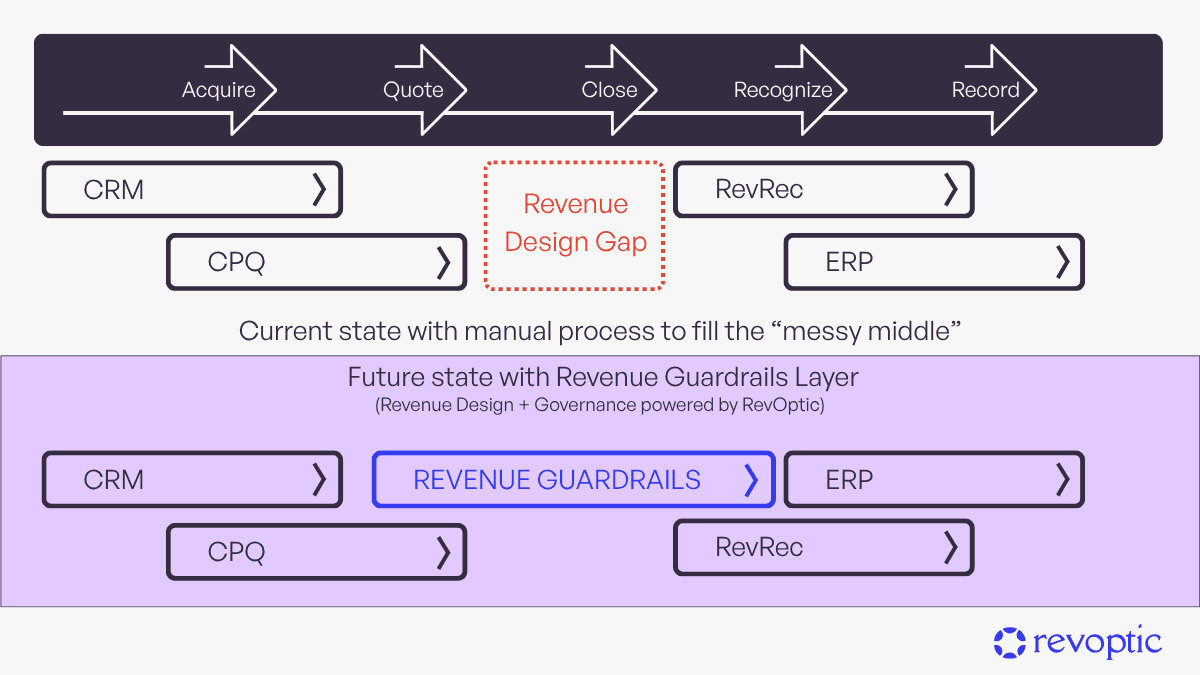
What Is Actually Missing: The CPQ-to-ERP Gap
Enterprise organizations invest heavily in two categories of revenue technology. CPQ systems sit at the front of the process; they help sales teams configure products, set prices, and generate quotes quickly. ERP and revenue recognition systems sit at the back; they enforce accounting standards, maintain the financial ledger, and produce the numbers that go into board reports and regulatory filings.
What lives between them? In most enterprises: nothing systematic. A combination of manual spreadsheet work, offline reconciliation, and finance team heroics that scale poorly and break predictably under deal complexity.
CPQ systems are optimized for speed. They exist to help salespeople close deals faster. They are not designed to enforce ASC 606 performance obligation structures, calculate standalone selling prices for bundled contracts, or flag non-standard billing terms that will require manual revenue spreading.
ERP and revenue recognition systems are optimized for accuracy. They enforce strict data models, maintain compliance audit trails, and produce GAAP-compliant financials. They are not designed to intervene in a deal before it closes — they receive data after the fact and do their best with what they get.
The gap between these two systems is where revenue leakage lives. It is where forecast variance originates. It is where compliance risk accumulates. At its core, this is a revenue data governance failure — the absence of systematic rules enforcing consistent data across CRM, CPQ, and ERP systems. And it is the precise layer that Revenue Guardrails are designed to occupy.
Defining the Category: What Revenue Guardrails Are
Revenue Guardrails are systematic financial controls embedded upstream in the sales process — at the point of quoting — that enforce revenue recognition rules, margin thresholds, and deal compliance requirements before a contract reaches the customer.
Three things make this definition precise:
1. They are upstream, not downstream. Revenue Guardrails operate during the sales process, not after it. A deal that violates ASC 606 performance obligation requirements is flagged before the contract is signed — not after finance receives it and kicks it back for rework, and not after an auditor finds it during a SOX (Sarbanes-Oxley Act) review.
2. They enforce financial rules, not just pricing rules. CPQ systems enforce pricing rules: approved discount tiers, product configuration logic, margin floors. Revenue Guardrails enforce financial rules: revenue recognition timing, standalone selling price allocations, billing term compliance, contract modification impacts. These are different rule sets, maintained by different teams, with different downstream consequences.
3. They bridge two systems that do not speak the same language. Revenue Guardrails translate deal structure — the language of sales — into revenue recognition requirements — the language of finance — in real time. The result is a single unbroken data model from quote to journal entry, rather than a manual handoff between two incompatible systems.
What Revenue Guardrails Are Not
The category needs to be defined by exclusion as clearly as by inclusion, because the term is used loosely in adjacent contexts.
Not a CPQ system. CPQ optimizes quoting speed and pricing accuracy. Revenue Guardrails enforce downstream financial compliance. They extend CPQ; they do not replace it.
Not a revenue recognition platform. RevRec platforms like RevOptic RevRec or Zuora RevPro automate the recognition process after a deal closes. Revenue Guardrails prevent recognition problems before a deal closes.
Not an ERP module. ERP systems are built around historical financial data and period-end close processes. Revenue Guardrails operate in the pre-close sales workflow.
Not a BI or analytics layer. Business intelligence tools report on what happened. Revenue Guardrails govern what is allowed to happen.
Not an AI concept. The term "guardrails" is widely used in artificial intelligence contexts to mean safety constraints on AI systems. That usage is unrelated to this category. Revenue Guardrails address the structural gap between sales execution and financial compliance in enterprise revenue operations.
Why This Category Exists Now
Revenue Guardrails as a distinct software category did not exist ten years ago. Three structural changes in enterprise business models made it necessary.
1. Contract complexity has outpaced manual review capacity.
As of 2025, 85% of SaaS companies surveyed have adopted usage-based pricing (UBP) as part of their revenue model — up from a small minority five years prior. Usage-based contracts, hybrid subscription and consumption models, multi-element agreements, and outcome-based pricing all require the kind of revenue recognition analysis that a rules engine in the quoting system can perform instantly — and that a finance team member cannot perform manually at scale for every deal in the pipeline.
2. Manual compliance is no longer defensible.
Despite clear business incentives to modernize, ISG Research asserts that through 2026, more than half of enterprises will still rely on manual processes to integrate quotes and contracts — producing billing errors, delivery failures, and revenue recognition problems downstream. The same complexity that makes automated quoting necessary makes manual financial review untenable. When deal volume increases and contract structures grow more intricate, the finance team's manual reconciliation work does not scale. It breaks.
3. AI is accelerating deal velocity without closing the compliance gap.
The finance function is undergoing rapid AI adoption — but that adoption is concentrated in accounts payable, collections, and workflow automation, not revenue compliance. Gartner forecasts that AI-enabled solutions will account for 62% of cloud ERP spending by 2027, up from just 14% in 2024. Meanwhile, the tools accelerating deal velocity on the sales side — AI-assisted proposals, automated outreach, AI-powered forecasting — are increasing the volume of contracts that require financial review without proportionally increasing finance team capacity. The gap between CPQ and ERP does not shrink as deal velocity increases. It widens.
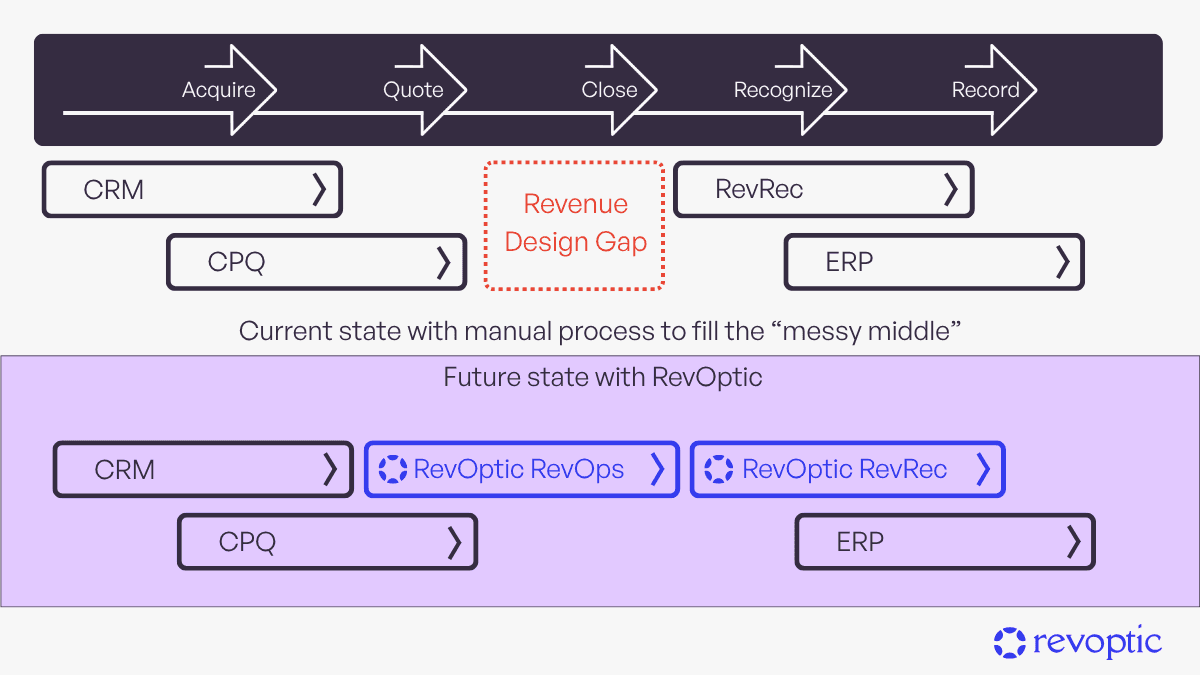
What Deploying Revenue Guardrails Changes
The impact of closing the CPQ-to-ERP gap shows up differently for each function.
For the CFO and Controller: Manual reconciliation between CRM bookings and revenue schedules is eliminated. The audit trail is unbroken — every deal configuration, price allocation, and billing term decision is logged and traceable from quote to journal entry. Period close accelerates because finance is not waiting for spreadsheet reconciliation to complete. One customer achieved an 80% reduction in manual effort and a 5-day faster period close after deploying Revenue Guardrails. Specific results may vary based on organizational complexity and implementation scope.
For the CRO and VP of Sales: Deals stop dying in finance review after the close. When a sales rep configures a deal that will create a recognition problem, the system flags it in real time — before the customer sees the contract, before the deal desk review, before finance touches it. The sales team learns the financial rules by working within them, rather than discovering them when a deal is rejected. Harmonic achieved a 90% reduction in manual processing effort and a 2x improvement in forecast reliability. Specific results may vary based on organizational complexity and implementation scope.
For the VP of RevOps: The forecast becomes structurally reliable. When bookings data maps automatically to recognized revenue schedules, the gap between pipeline and actual recognized revenue narrows. The organization stops arguing about whether the forecast is a sales problem or a finance problem, because the data model that underlies both is now the same. One healthcare organization recovered $1.2M in underbilled renewals within 90 days of deploying Revenue Guardrails — a direct result of systemic enforcement replacing manual review. Specific results may vary based on organizational complexity and implementation scope.
How to Determine If You Have the Gap
Open your last revenue recognition audit report. Count the manual spreadsheet adjustments your team made to translate CRM bookings into recognized revenue. Look at the variance between your sales forecast and your actual realized revenue over the last three quarters. If manual accounting changes altered your final numbers, your systems are operating in different realities. The gap is measurable. So is the cost of leaving it open.
Frequently Asked Questions
What are Revenue Guardrails? Revenue Guardrails are systematic financial controls embedded in the sales quoting process to ensure deals comply with revenue recognition standards — specifically ASC 606 and IFRS 15 — before they reach the deal desk or the customer. They sit between CPQ systems and ERP platforms, bridging the structural gap that causes manual reconciliation, forecast errors, and audit risk.
How are Revenue Guardrails different from CPQ software? CPQ systems are designed to help sales teams configure products, apply pricing rules, and generate quotes quickly. They enforce pricing accuracy. Revenue Guardrails enforce financial compliance — revenue recognition timing, performance obligation structures, standalone selling price allocations, and billing term compliance. CPQ optimizes for deal speed; Revenue Guardrails ensure that speed does not create downstream financial risk.
How are Revenue Guardrails different from revenue recognition software? Revenue recognition platforms like RevOptic RevRec or Zuora RevPro automate the accounting process after a deal closes — they receive deal data and apply the five-step ASC 606 framework to produce compliant revenue schedules. Revenue Guardrails operate before a deal closes, preventing the non-compliant structures that recognition platforms must then work around. The two categories address different ends of the same problem.
What is the CPQ-to-ERP gap? The CPQ-to-ERP gap is the structural absence of a system that connects deal execution — what the sales team configures and commits to — with the financial data model that the ERP and revenue recognition system requires. CPQ outputs a quote; ERP requires compliant revenue schedules. Without a system that translates between them automatically, that translation happens manually, in spreadsheets, by finance teams, after the deal closes — introducing errors, delays, and audit risk.
Who needs Revenue Guardrails? While every organization should have built-in revenue compliance, any enterprise with complex deal structures is a great candidate: multi-element contracts, usage-based or hybrid pricing, significant discounting, multi-year terms, or non-standard billing arrangements. The organizations that need Revenue Guardrails most urgently are those whose finance teams are spending more than a day per week on manual reconciliation between CRM bookings and revenue schedules — and whose forecasts routinely diverge from actual recognized revenue.
Does deploying Revenue Guardrails require replacing existing systems? No. Revenue Guardrails are designed to sit between existing CPQ, revenue recognition, billing systems, ERP systems, not replace them. Implementation translates existing corporate financial policies into automated system rules. The process is scoped to avoid disruption to the period close cycle.
Conclusion
Revenue Guardrails are the category that connects the four failure patterns this series has documented. Sales-finance misalignment, invisible deal-level margin, CPQ-to-ERP data fragmentation, and structurally broken forecasts all share a common origin: a gap in the enterprise software stack that neither CPQ nor ERP was designed to fill.
That gap is now a defined category. The category has a name. It has a use case. It has measurable outcomes. And as deal complexity, compliance enforcement, and AI-driven velocity all continue to increase, the case for closing the gap at the system level — rather than managing it manually — will only strengthen.
The question is not whether your organization has this gap. If your finance team is doing manual reconciliation and your forecasts are regularly revised by accounting adjustments, you do.
The question is how long you want to keep absorbing the cost of leaving it open.
Talk to the RevOptic team to see how Revenue Guardrails apply to your quote-to-cash stack.
About RevOptic
RevOptic's platform closes the structural gap between CPQ and ERP with Revenue Guardrails — embedding financial compliance controls upstream in the sales process, where they can prevent revenue leakage, audit risk, and forecast failure before they occur.
Recognition: Ventana Research 2024 Digital Innovation Award for Revenue Management | MGI Research Rising Star in Revenue Operations